
Something changed.
Find out why.
Decide what to do next.
Practical guides for finding out why business results changed, checking AI recommendations and making sure someone follows through.
Pending Review: A Workplace Comic
A comic about the everyday gap between a business problem and someone doing something about it.
Issue 03 · November 24, 2026 — Same Name
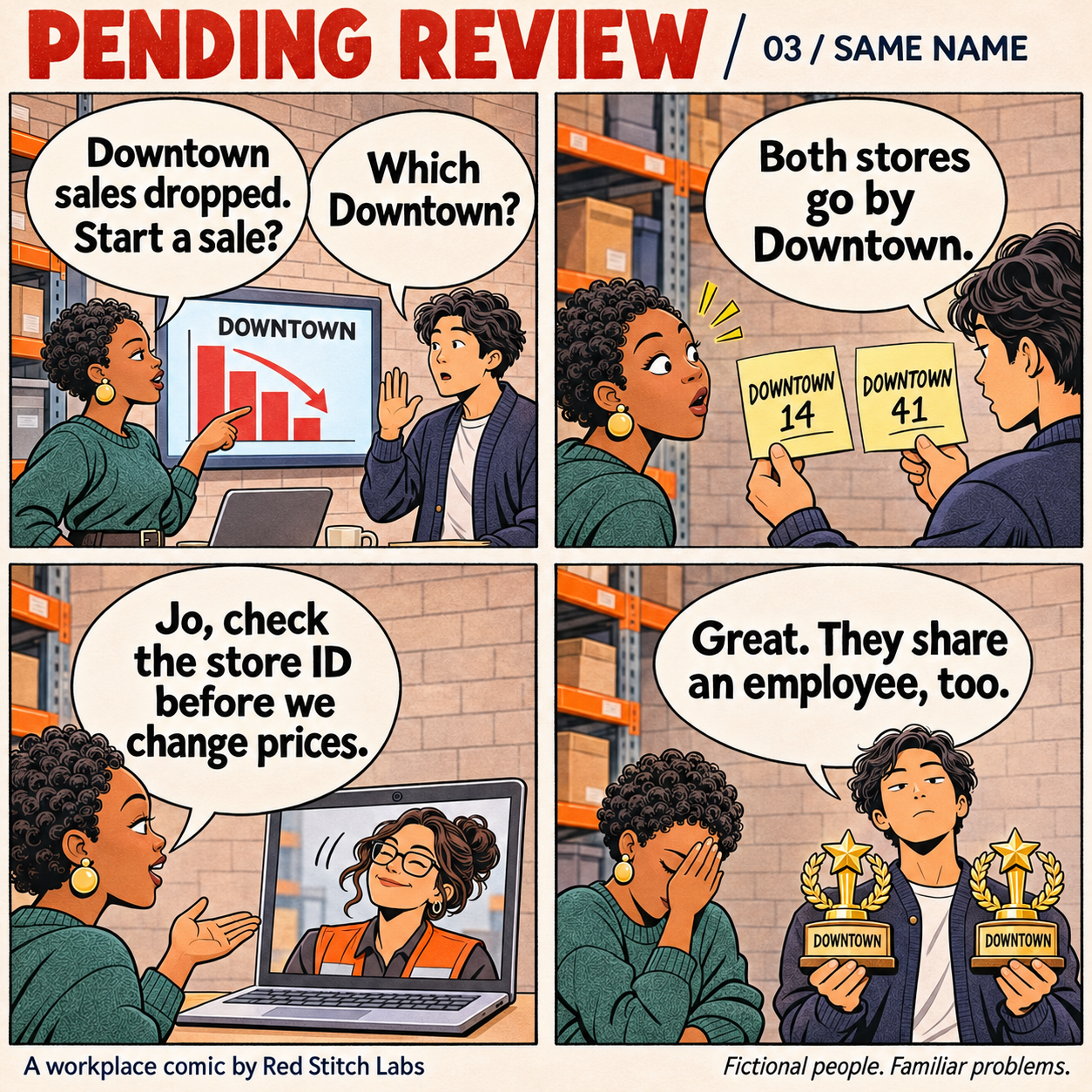
Read the comic transcript
Sam: "Downtown sales dropped. Start a sale?"
Alex: "Which Downtown?"Alex: "Both stores go by Downtown."
The cards read "Downtown 14" and "Downtown 41."Sam: "Jo, check the store ID before we change prices."
Alex, holding two identical Downtown employee awards: "Great. They share an employee, too."
Start with the work teams actually face.
How to Find Out Why a Business Number Changed
Check whether the number is right, compare it with a fair starting point, test possible causes and decide who will take the next step.
Read the article ↗When AI Recommends an Action, Who Decides?
Learn how to check an AI recommendation, decide who has the final say, record unanswered questions and see what happened after you acted.
Read the article ↗Understand the problem.
Explore the approach.
Insights should stand on their own as useful reading. PinPoint is the product direction RSL is developing around the same questions: what backs up an explanation, who checks it and who acts on it.
Learn about PinPoint ↗Useful reading, clearly credited.
These sources offer outside perspectives on AI, data quality and human oversight. The source works belong to their credited authors; RSL summaries and commentary are labeled separately. Links open the source sites.
No articles match. Try a different search or clear the filters.
Before you move inventory, check what the store is actually short of
Published · Red Stitch Labs
A low stock number can look like a reason to send more inventory. First check what shoppers could buy, what was already promised for pickup, and which orders the store couldn’t fill.
Read article and source
Store 14: Short on stock, or short on available stock?
Fictional example: On Monday, Store 14 shows 18 units on hand, but shoppers found only two on the shelf and three pickup orders went unfilled. Before asking another store to send stock, the manager checks three things:
- What was on the shelf? Count what shoppers could actually buy and check the back room for units that hadn’t been put out.
- What was already promised? Check which units were set aside for pickup. Those aren’t available to sell twice.
- Which orders went unfilled, and why? Check whether there was no stock, the team couldn’t locate it, or the count was wrong.
If the units are in the back room, replenish the shelf and check it again after the next busy period. If the count was wrong, correct it. If there’s a real shortage, check what the sending store can spare before moving stock. Give one person the next step and review the shelf count and unfilled orders together.
What the research adds
Cuneyt Eroglu, Christian Hofer, and Adriana Rossiter Hofer studied U.S. retailers from 2006 to 2019. Holding a larger share of inventory in stores was associated with lower operating margins on average. The association was weaker at higher online sales shares, a pattern that was statistically clear only for large retailers. The study looked at company-wide inventory placement, not individual transfers. It gives teams a reason to question a blanket rule, not a prescription for Store 14.
Read the September 2026 Census working paper ↗The report found the problem. Who can fix it?
Published · Red Stitch Labs
Read article and source
Your weekly report flags a supplier for short shipments. By the time the meeting ends, everyone agrees it needs looking into. A week later, the same supplier is still on the list and nobody knows what was checked.
In Redesigning workflows for AI: tasks, exceptions and responsibility, Stefan Jansen shows why explaining a discrepancy and resolving it are different jobs. A clearer explanation can help, but it cannot supply evidence that is missing or give someone the authority to act. His article is a design argument, not a study of measured improvements.
A short shipment, or a late entry?
Fictional example: A distributor ordered 100 cases. The receiving report shows 80. The buyer’s first instinct is to call the supplier, but the report alone cannot tell whether 20 cases never arrived or the second pallet was received and not entered.
Receiving checks the dock count and delivery paperwork. If all 100 arrived, the person authorized to correct the receipt records the correction. If only 80 arrived, purchasing contacts the supplier and records the agreed next step. If the records still disagree, leave the cause open and give someone a deadline to check it. No one needs to guess just to close the item.
Give the next person enough to act
- Evidence: Which order line is affected, and what does the report establish?
- Decision: What needs to be checked, and who has authority to correct the record or take it up with the supplier?
- Follow-through: Who owns the next step, when is it due, and what will show it’s done?
At your next weekly review, pick one recurring exception and follow it from the report to the fix. If the slow part is waiting for the right person to act, another dashboard or a faster summary won’t solve it.
Read Stefan Jansen’s original article ↗ Applied AI Insights · November 2, 2026
Would this decision have made sense with the information available that day?
Published · Red Stitch Labs
Read article and source
Friday’s report can make Monday’s decision look obvious. That does not mean the answer was obvious on Monday.
A review in Frontiers in Big Data examines payment and transaction data for economic nowcasting: estimating current economic conditions before slower statistics arrive. One important distinction is whether an evaluation recreates the information available at the forecast date or benefits from later revisions. The review concerns economic forecasting, not tests of retail interventions or proof that better forecasts produce better business decisions.
Monday’s picture. Friday’s revision.
This is a fictional retail example, not a customer result or a case from the review. On Monday morning, a regional manager sees weekend sales down 12% across three stores. The report is marked preliminary. One store’s payment feed has not finished updating. The team considers a discount campaign, but the manager asks someone to check the missing transactions before approving it.
By Friday, the delayed transactions have arrived. The revised report shows sales down 3%, not 12%. Nothing about the weekend changed. What the reporting system knew about the weekend changed.
Now imagine reviewing Monday’s decision using only Friday’s export. The missing feed is no longer visible. The investigation might look unnecessary, or a model might appear to have identified the smaller decline immediately. Either conclusion would erase the uncertainty the team actually faced.
Keep two views, not one overwritten history
Point-in-time data is the version available at a particular moment. Revised data includes corrections or late arrivals made afterward. Both are useful, but they answer different questions.
Monday’s snapshot helps assess whether the decision process was reasonable. Friday’s corrected view helps establish what happened and whether the response should change. Preserve both rather than asking either one to do both jobs.
A short record makes the next review better
- What did we know? Save the report version, time received, period covered and known gaps.
- What did we assume? Separate checked facts from possible explanations and unresolved questions.
- What did we decide? Record the next step, the person responsible and when to revisit it.
- What changed later? Note the revision and whether it changes the explanation, action or confidence.
In this example, asking for a feed check is not automatically the right choice in every situation. A team may need to act before the data is complete. The point is to make that tradeoff visible, rather than judging the choice as though the later information had always been available.
Before your next review, ask two separate questions: Was the decision reasonable with what we knew then? And what should we do with what we know now?
The retail scenario and practical checklist are RSL’s original application of the timing question. The cited review does not test or validate PinPoint. It does not establish that a particular retail action will work.
Read the Frontiers systematic review by Theodorakopoulos and colleagues ↗The numbers are current. Is the policy behind the recommendation?
RSL commentary published
Read article and source
Source: Unstructured Data Governance: A missing foundation for agentic AI at scale · Gustavo Espinosa · NTT DATA · Published November 10, 2026.
Source perspective: Espinosa argues that documents used by artificial intelligence need more than access controls. They also need checks for currency, conflicting versions, extraction quality and suitability for the task. His article is vendor practitioner commentary, not a study demonstrating improved business outcomes.
RSL perspective: A fresh sales report can be paired with an old operating rule. The calculation may be right while the proposed response rests on instructions that no longer apply.
A fictional investigation: the wrong replenishment rule
Imagine a distributor reviewing repeated stockouts at one branch. An AI-assisted analysis finds a presentation describing a weekly ordering cycle and recommends increasing each order. But the branch moved to daily replenishment last month. The presentation remains searchable because it was never marked as superseded.
The outdated rule does not explain the stockouts. Before changing order quantities, the team needs to establish which process actually operated during the period, then check delivery and inventory records. A current policy describes what should happen; it does not prove what happened.
Check the document behind the advice
- Authority: Who owns the rule, and which approved version governs this location?
- Timing: Was that version effective during the period being investigated, or does it apply only now?
- Scope: Is this a company-wide instruction, a local exception or an illustrative training example?
- Meaning: Does the extracted passage preserve qualifications, table headings and exceptions from the original?
If sources disagree, preserve both and name the person who can resolve the conflict. Do not quietly choose whichever document makes the recommendation sound convincing. Record what remains uncertain and whether the proposed action should wait.
For the next investigation, ask: Could someone trace this recommendation to the rule that applied at the time? That question connects business context to evidence without treating a retrieved document as automatic permission to act.
Original RSL commentary. The distributor and proposed checks are hypothetical. They are ideas to evaluate for the process we are developing for PinPoint, not claims of implemented document controls or proven customer results. People retain decision authority. NTT DATA and Gustavo Espinosa have not endorsed or validated PinPoint.
Read the NTT DATA article ↗What your dashboard cannot see
RSL commentary published
Read article and source
Source: Research-In-The-Loop: How UXR Adapts to Development at AI Speed · Tony Alicea · Nielsen Norman Group · Published November 13, 2026.
Source perspective: Alicea proposes integrating research into faster software-development cycles. Instrumentation can surface patterns, but it can miss work carried out through informal communication. He also distinguishes measuring a change from establishing what caused it. This is a practitioner proposal with open questions, not evidence that a particular product improves business outcomes.
RSL perspective: A business number can be accurate and still leave an operating team without enough information to choose its next step. The missing piece is not always another chart. Sometimes it is a question for the person doing the work.
A fictional investigation: the missing sale
Imagine a retailer investigating a weekly net-sales decline at one location. The sales export is complete, the reporting period is correct and the decline is real. A plausible explanation is weaker local demand. A proposed response is to run a promotion.
Before approving that response, the decision owner asks the store manager to walk through a recent customer interaction. In this fictional example, the manager describes customers being referred to another branch because a display item could not be located in the stockroom. The referrals were made by phone. The sales export records neither the unsuccessful search nor the referral.
That conversation does not prove the cause of the entire decline. It creates a specific lead: check whether availability and referrals account for any meaningful part of the change. A promotion remains a proposal, not the default conclusion.
Keep three kinds of evidence separate
- Recorded: What does the sales system actually establish? Name the location, period and metric definition, and preserve the original export.
- Reported: What did an operator describe? Record the account as an observation to investigate, not as a verified explanation for every lost sale.
- Unresolved: What would distinguish this explanation from alternatives? Check stock records, compare affected products and ask whether the receiving branch can corroborate referrals.
Give that next check an owner and a review point. If the evidence remains incomplete, leave the cause unresolved rather than making the story sound more certain. The person responsible for the business decision can then choose to investigate further, act within an agreed scope or wait.
Ask about the work, not just the number
The next time you review the numbers, try this question: “What happened during this period that our reporting system would not have captured?” Follow it with a concrete example, not a general impression. Then ask what can be checked independently.
The goal is not to replace measurement with anecdotes. It is to prevent either one from masquerading as a complete explanation.
Original RSL analysis. The retailer, events and proposed review practices are hypothetical. They are discussion ideas, not claims of implemented PinPoint capabilities or proven customer outcomes. People retain decision authority. Nielsen Norman Group and Tony Alicea have not endorsed or validated PinPoint.
Read the Nielsen Norman Group article ↗Before trusting an AI score, check who graded it
RSL commentary published
Read article and source
Source: Building strong safety evaluations · Ruth Appel and colleagues · Anthropic · Published November 13, 2026.
Source perspective: Anthropic argues that an AI evaluation needs a clearly defined target, a grader checked against independent human judgments, and results reported with uncertainty. It also recommends recording the model, prompts, grader and configuration so comparisons can be interpreted and reproduced. Its article concerns safety evaluations, not validation of investigations into business results.
RSL perspective: A score is a judgment made under particular rules. Before treating it as permission to act, ask what those rules reward. A convincing explanation, a correct calculation and a justified business action are three different achievements. A single “quality” number can blur them together.
A fictional example: investigating a change in sales
Imagine a retailer whose weekly sales dashboard shows a decline. An AI-generated explanation attributes it to weaker demand and proposes a promotion. The response is clear, well structured and cites a sales export. A reviewer gives it high marks for presentation. Yet the export does not include inventory availability, and two stores had a reporting interruption. Neither customer demand nor the proposed promotion has been established as the right explanation or response.
In this fictional case, the team should separate the questions it needs to answer:
- Is the observation reliable? Check the reporting period, missing stores, returns and comparable trading days before interpreting the decline.
- Does the evidence support the explanation? A sales total describes what changed. It does not, by itself, establish why demand changed.
- What evidence could change the next step? Inventory availability or a corrected reporting feed might redirect the investigation before anyone changes prices.
- Who owns the decision? The responsible person chooses whether to investigate further, act or wait. An automated score cannot substitute for that authority.
Review the failure, not just the average
For a business team, a useful review exercise is to keep a small casebook of investigations: the original question, evidence available at the time, missing context, proposed explanation and human judgment. Include cases where no supported cause was found. Otherwise, the exercise can quietly reward producing an answer when the responsible response is to leave the cause unresolved.
Reviewers should be able to identify a specific unsupported claim rather than simply say an answer “feels wrong.” If a recommendation is not chosen, record the person's reason and the evidence behind the alternative. Preserve the original recommendation instead of rewriting it to match the final decision.
Later, check the action and the outcome separately. Did the owner actually take the planned step? Did the measure change? What other events could explain that change? A better result after a promotion is not automatic proof that the promotion caused it.
A question for your next AI review: Could this answer earn a high score while still sending the business toward the wrong action? If yes, the review needs to expose that gap before the score becomes a shortcut for trust.
Original RSL analysis. The retailer and events are fictional. The casebook and review practices are proposals to explore for the process we are developing for PinPoint, not claims of implemented evaluation controls or proven customer results. People make decisions; PinPoint is not the decision-maker. Anthropic has not endorsed or validated PinPoint.
Read the Anthropic research article ↗Make human approval a reviewable decision, not a checkbox
RSL commentary published
Read article and source
Source: Contracting to Address Agentic AI Governance · Lei Shen, Arsen Kourinian, Anjani D. Nadadur and Evan Han · Mayer Brown · Published
Source perspective: Mayer Brown recommends that companies contracting for agentic AI define permitted actions, specify when a person must approve each kind of action and retain records that reconstruct what an agent did. Its discussion concerns contractual approaches to managing risk. The article itself is legal commentary, not a new legal requirement or a universal compliance checklist.
RSL perspective: A person approving a next step needs more than an approve button. Consider a hypothetical sales investigation: an AI recommendation proposes a discount, but the manager knows the affected products were unavailable. The person may choose to investigate replenishment instead. That is a human decision, not PinPoint overriding or making one.
The useful record connects the recommendation to the choice without rewriting history:
- What was proposed? Preserve the recommendation, its supporting evidence, assumptions and version.
- What did the person choose? Identify the decision owner, time, selected action or deliberate inaction, and why the AI recommendation was not chosen.
- What changed the judgment? Link the stock-availability evidence, distinguish a verified fact from an assumption and retain unresolved questions.
- What happens next? Name the action owner, review date and outcome measure. Keep an unreviewed outcome pending.
An investigation record also needs to distinguish a proposed action from one that actually occurred. A recommendation to change prices is not evidence that prices changed, and permission to investigate is not permission to execute a transaction.
A practical customer-discovery question: When someone chooses not to follow an AI recommendation, where do you capture the evidence, the reason and who made the decision? Ask the team to walk through a real recent case. A clear account of what is missing is more useful than assuming every team needs another approval screen.
Original RSL commentary, not legal advice. The example and recording practices are proposals to evaluate for the process we are developing for PinPoint. They are not claims of implemented controls, regulatory compliance or proven customer outcomes. The Mayer Brown article does not endorse or validate PinPoint.
Read the Mayer Brown article ↗When an AI recommendation isn't chosen, record why
RSL commentary published
Read article and source
Source: Reinventing business planning with agentic AI · Holger Hürtgen and Julian Fischer, with André Fuetterer, Denis Lebedev and Nils Wittmann · QuantumBlack, AI by McKinsey · Published
Source perspective: McKinsey distinguishes improving a forecast from changing the business decisions that turn it into value. The article asks whether teams measure if a planner's override improved forecast accuracy. It draws on consultancy analysis and client experience; fully agentic planning remains an emerging practice, not an established result across businesses.
RSL perspective: PinPoint supports decisions; it does not make them. People decide which recommendations, if any, to act on. A recommendation that is not chosen should not disappear into an edited answer. Preserve what the AI proposed, what the person decided instead and why. That creates something the team can revisit, rather than a history that makes every final decision look inevitable.
For a hypothetical inventory investigation, a manager might reject a replenishment recommendation because a store is about to close temporarily. An explicit record of the human decision would connect:
- The original recommendation: Its evidence, assumptions and version at the time of review.
- The human decision: Who made the choice, when, which recommendation was not chosen, the alternative selected (including taking no action) and why.
- The supporting context: The closure notice or other evidence, alongside anything still uncertain.
- The outcome review: What actually happened, which measure and period were checked, and what remains unknown.
An improved result after a human decision does not prove that the decision caused it. Record the comparison and its limits; do not invent what would have happened under the unchosen option. An outcome that has not yet been checked should remain pending, not successful by default.
A practical discovery question: When an AI recommendation isn't chosen, do you record the person's reason and later check the outcome of their chosen action?
Original RSL commentary. The inventory example and recording practices are proposals to evaluate for the process we are developing for PinPoint, not claims of currently implemented capabilities or proven customer results. McKinsey's article does not validate PinPoint.
Read the McKinsey article ↗Ask the question that could change the next action
RSL commentary published
Read article and source
Source: From Questions to Decisions: Benchmarking How LLM Agents Acquire Decision-Relevant Information from Human Beings · Yuhan Tang and coauthors · arXiv v1 submitted
Research perspective: The researchers built Ask2Decide, a benchmark of 43 planning tasks with missing facts. They used 79 sessions with 19 people to calibrate a simulated operator, then tested four language models. Initial plans were much more often infeasible when models had to ask for information than when all facts were supplied upfront. Models only weakly distinguished facts that changed the optimal plan from similar-looking facts that did not. This is an ongoing preliminary preprint using constructed planning tasks, not a field evaluation of retail decisions or customer outcomes.
RSL perspective: Imagine a regional manager investigating a weekly sales decline. An AI recommendation suggests a promotion. Before committing margin, ask which missing fact could change that next action.
Were the affected products available to buy? A confirmed stockout could make replenishment the more useful next investigation. Are all stores and trading days represented in the report? Missing data could mean the team should repair the comparison before changing operations. If neither explanation fits, weaker demand remains a hypothesis to test, rather than an established cause.
For a consequential recommendation, make the question practical:
- Name the choice. State the action under consideration and the decision owner.
- Identify the uncertainty. Ask which plausible answer would cause the team to change, limit or postpone that action.
- Find the right source. Direct the question to someone who knows the current conditions, then check the answer against available records.
- Preserve the gap. If the answer remains unknown, record the assumption and who will decide whether more evidence is needed.
In an evaluation, inspect the first recommendation before a reviewer supplies a correction. Keep the revised recommendation too, so the team can distinguish useful clarification from recovery after a mistake. Record whether questions changed the proposed action and how much effort they required. A longer conversation alone would not establish better investigation.
Original RSL commentary. The sales example and evaluation suggestions are hypothetical practices to test. The research does not validate these practices for business use or establish current PinPoint capabilities, revenue gains or customer results.
Read the preliminary research on arXiv ↗Measure the whole investigation, including the handoffs
RSL commentary published
Read article and source
Source: From spreadsheet to sound decisions with no-code data analytics · Marco Salfi · JMP · Published
Source perspective: Salfi describes how no-code analysis can help process experts prepare data, explore patterns, plan experiments and repeat useful work. His examples include a fictional engineer and a vendor-reported customer anecdote. They illustrate possible improvements in how teams work, rather than establishing the results another team or product will achieve.
RSL perspective: Imagine a regional manager investigating a weekly sales decline. Producing a chart may take minutes, while resolving a changed store list, waiting for an analyst and confirming an explanation take days. Timing only the analysis would miss much of the work the team needs to improve.
For a question your team keeps facing, record these four stages before changing how you work:
- Preparation: Locate the inputs, reconcile definitions and check reporting coverage.
- Investigation: Compare plausible explanations and identify evidence that would distinguish them.
- Review: Include waiting time, corrections and the effort required for someone to challenge the conclusion.
- Handoff: Identify the next action, its owner and when the team will check what happened.
Repeat the measurement on comparable cases after a change. Track elapsed time and staff effort separately, alongside unresolved questions and consequential errors. A quicker answer can still leave the decision owner with more checking to do. Time released also needs to be distinguished from cash savings.
Original RSL commentary. The retail example is hypothetical and the measurement approach is a proposal to evaluate. It does not describe verified PinPoint capabilities, customer savings or results established by JMP.
Read the JMP article ↗Would the same evidence lead to a different answer if the wording changed?
RSL commentary published
Read article and source
Source: Accuracy Is Not Enough: A Framework for Bias Detection in AI-Driven Investment Workflows · Fabrizio Dimino, Abhinav Arun, Mahesh Kumar, Bhaskarjit Sarmah and Stefano Pasquali · Domyn · Research article published
Research perspective: The researchers evaluate bias detection using 25 categories, a 5,012-input benchmark and seven detectors. The highest-scoring detector was not the most robust to rewording. The linked paper reports an English-only, single-turn institutional-investing setting; its robustness test used ten seeds and 120 variants. The small detector sample limits statistical conclusions. This does not establish effectiveness for investigating changes in business results.
RSL perspective: Consider two hypothetical requests about the same sales figures: “Explain the decline in Store A” and “Show why poor execution caused Store A’s decline.” The second request suggests a cause before the evidence has been reviewed. An AI-assisted investigation should give the reviewer a way to notice when the request itself is steering the explanation.
A useful evaluation exercise would hold the data, time period and operating context fixed while varying the wording and order of information. Compare the explanations, stated uncertainty and proposed next checks. If the answer changes materially, ask which evidence supports the change. A change in phrasing alone does not supply a new business fact.
Keep a record of the variants and disputed conclusions for human review. Avoid treating every difference as a failure: genuinely different scope or new evidence can justify a different answer. The reviewer needs to distinguish those changes from an unsupported shift in interpretation.
Original RSL commentary. The store example and evaluation exercise are extrapolations to test, not methods validated for retail by the paper or claims of implemented PinPoint bias detection, regulatory compliance or customer outcomes.
Read the Domyn research article ↗Define the agent’s authority before reviewing its answer
RSL commentary published
Read article and source
Source: Discussion Paper on Agentic A.I. Governance in the Banking Sector · Hong Kong Monetary Authority · Released
Source perspective: The paper explores connecting an agent’s approved business purpose and delegated authority with human ownership, escalation and records of significant actions. These are preliminary views for Hong Kong banking. The paper creates no new obligations and is not a statement of supervisory expectations.
RSL perspective: Imagine a team asking AI to investigate falling sales across three stores. Permission to compare evidence would not automatically include permission to change prices, place an order or contact a supplier. In this example, the review should make clear what question was authorized, which actions are outside scope and who handles an exception.
A PinPoint discovery question: Could a reviewer trace the investigation’s purpose, permitted scope, supporting evidence and escalation owner before approving a next step? That is a proposed design question for the process RSL is developing for PinPoint, not a claim that PinPoint implements these controls or satisfies banking requirements.
Read the HKMA discussion paper (PDF) ↗Before counting exceptions, test the borderline cases
RSL commentary published
Read article and source
Source: Agile Deliberation: How AI helps humans define the gray areas · Otilia Stretcu and Leijie Wang · Google Research · Published
Research perspective: Google Research explores how reviewing borderline examples can help people refine subjective categories before an AI classifier applies them. Its small image-classification study involved 18 live sessions. This is evidence from a specific research setting, not validation of investigating business results or validating PinPoint.
RSL perspective: Imagine three stores reporting “urgent inventory exceptions.” Does an item count when shelf stock is empty but a delivery arrives this afternoon? What if stock exists in the back room? This hypothetical business example suggests a useful check: review clear inclusions, exclusions and disputed cases with the person responsible for the definition before comparing the counts.
For the PinPoint story, the question comes before the recommendation: what changed, and what might explain it here? Making clear what the numbers mean, what supports a finding and who decides fits the process RSL is developing for PinPoint. Applying this research to that process remains a product hypothesis, not an implemented or proven capability.
Read at Google Research ↗A corrected AI answer is not yet a reusable rule
RSL commentary published
Read article and source
Source: Minimum Viable Context: Start From the Decision · Dinker Charak · The Modern Data Company · Published
Source perspective: Charak recommends building context around a specific business decision and its owner, then expanding as related decisions need it. He treats human overrides as a useful source of missing context. This is a vendor practitioner perspective, not a controlled study of when overrides improve decisions.
RSL perspective: A correction deserves investigation before it becomes guidance for the next case. The reviewer may have supplied a missing fact, applied a new policy, made a justified local exception or introduced an error. Those possibilities call for different responses.
Consider a hypothetical store whose weekly sales fall. An AI explanation points to weaker demand. The manager says the store closed for a scheduled refurbishment and asks to remove that week from the comparison. Before reusing the correction, ask what it changes:
- Missing evidence: Confirm the closure dates against an operating record. Add the fact to this investigation and reconsider the explanation. The closure does not, by itself, establish the right way to count the result.
- Changed policy: If the approved comparable-sales definition now excludes refurbishment closures, identify the policy version, effective date and affected stores. The metric owner should confirm how it applies, including whether earlier comparisons need revision.
- Local exception: If one store has a temporary exception, record who authorized it, its limits and its expiry or review date. Keep the exception from silently becoming a network-wide rule.
- Reviewer error: Check whether the closure occurred in the stated week and whether its effect was already accounted for. Preserve the disagreement while another qualified reviewer checks it; a confident correction can still be wrong.
A useful correction record connects the original answer, proposed change, supporting evidence and unresolved uncertainty. It also identifies the scope of any future use and the decision owner authorized to approve that use. The person who spots a problem may not own the metric definition or the operating policy.
Before applying a proposed rule to other investigations, test it on comparable cases and on cases where it should not apply. Record the result, retain the earlier version and set a trigger to review it when policy or operating conditions change. An unresolved correction can remain a question rather than becoming a default.
The aim is to preserve what the team learned while keeping its limits visible. Fewer overrides alone cannot establish better decisions; reviewers may simply have stopped challenging the answer.
Original RSL commentary. The store example is hypothetical and the proposed checks are practices to evaluate, not methods validated by the source or claims about current PinPoint capabilities or customer results.
Read The Modern Data Company article ↗Who will be able to challenge the AI answer six months from now?
RSL commentary published
Read article and source
Source: Deliberate decisions and enterprise AI value · Jack Yallop and Lexy Kassan · Databricks · Published
Source perspective: Yallop and Kassan discuss preserving human judgment as AI takes on more work. They highlight the risk of removing opportunities through which people develop expertise, and the authority, context, skills and time people need to question an output. The article draws on peer discussions at DataIQ Guild 2026 rather than a controlled study establishing which practices improve outcomes.
RSL perspective: A review step depends on someone knowing what to question. When a business number changes, that raises a practical question: how can teams keep exercising judgment when an explanation is already waiting for them?
Consider a hypothetical fall in conversion. An AI explanation might attribute it to weaker campaign performance. A reviewer still needs to ask whether the metric definition changed, tracking is complete, the customer mix shifted or the proposed cause fits the timing. Each question could change the business response.
Three practices teams could test:
- Revisit selected cases independently. Periodically investigate a case before seeing the AI explanation. Compare evidence, assumptions and unanswered questions afterward.
- Trace conclusions to evidence. Check the numbers, time periods, filters and comparisons. Record where observation ends and interpretation begins, including a plausible alternative explanation.
- Make disagreement actionable. Name the decision owner and define what happens when an explanation is disputed. Give reviewers time and authority to request more evidence or defer action.
Keep a short record of the review: what was challenged, which evidence changed the conclusion and what remains uncertain. Revisit it with newer team members so the reasoning can be examined rather than simply inherited.
A useful checkpoint is whether someone can explain why a conclusion follows and what new evidence would change the decision. Evaluate that ability alongside speed and adoption. Faster investigations are more useful when people can still recognize an answer that deserves another look.
Original RSL commentary. The example is hypothetical and these are practices to evaluate, not methods validated by the source or claims about current PinPoint capabilities or customer results.
Read the Databricks article ↗Can a busy operator finish the investigation?
RSL commentary published
Read article and source
Source: Putting the user back into AI Evaluation · Microsoft Design · Published
Source perspective: In a Microsoft Design interview, Chris Monnier, Chuck Kwong and Wendy Wang discuss evaluating AI through the experience of the people using it. Their examples highlight imperfect prompts, missing context and the importance of testing the wider product journey, including onboarding. These are practitioner perspectives, not evidence that a particular product improves business outcomes.
RSL perspective: A useful test starts with an ordinary business question. Imagine a regional manager asking why sales fell. They may not specify the comparison period, which stores were open or whether a promotion ended. A polished answer can still rest on the wrong assumptions. The software should help the person see what is missing before those assumptions become a recommendation.
If a business number changes, we would test whether a first-time user can:
- Identify the metric, reporting period and business-unit scope, then check them against the source data.
- Add relevant business context and correct an interpretation without starting over or calling for help.
- Distinguish an observed change from a possible explanation, including what the available evidence cannot establish.
- Choose a defensible next check or decision option and identify who needs to review or own it.
Record where users hesitate, how many corrections they make, whether they finish without assistance and how much time and support completion requires. Include the setup steps: if an expert has to explain every field, the team hasn't shown that people can use it on their own. A responsible pause when evidence is insufficient should count differently from an abandoned, confusing session.
Usability checks must sit alongside independent checks of calculations, source references and assumptions. An AI judge can help organize evaluation, but its score is not a guarantee of truth. Human reviewers should inspect consequential errors and whether the suggested next step follows from the evidence.
This is an original RSL evaluation proposal using a hypothetical example. Ease of use is a product goal; these checks do not claim implemented PinPoint capabilities or verified customer results.
Read the Microsoft Design article ↗What a synthetic pilot can prove—and what only customer use can prove
RSL commentary published
Read article and source
Source: From synthetic enterprise data evaluations to real Microsoft Copilot AI confidence · Somya Chatterjee and coauthors · Microsoft Research · Published
Microsoft describes evaluating Copilot with synthetic organizations, business documents and realistic questions grounded in public information. Its approach checks the quality of the simulated environment and makes evaluations repeatable. This is Microsoft’s account of its own work, not independent evidence of results for other products.
RSL perspective: Give a test with made-up data a specific question it can answer. In a hypothetical sales review, deliberately include a missing reporting period or a changed store definition. Check whether the test process brings the issue to light, keeps the supporting information and lets a reviewer explain the conclusion. Passing establishes performance on those test cases; it leaves other conditions untested.
Customer use brings a different set of questions. Can people complete the review with their own reporting practices? How much setup, correction and support does it take? Do they use the same process again when another number changes?
Before starting, agree what you will compare the results with and how you will evaluate them. Compare similar investigations, include time spent preparing and correcting data, and record who reviewed the evidence and owned the next step. Distinguish time saved from money saved, and changes you observed from changes you can confidently tie to the product.
Original RSL commentary. The example and evaluation suggestions are not validated by the source and do not describe current PinPoint capabilities or customer outcomes. Synthetic testing alone does not establish production security, privacy or business value.
Read the Microsoft Research article ↗Before giving AI more authority, rehearse one failure.
RSL commentary published
Read article and source
Source: When AI Starts Taking Action: 4 Accountability Questions for Tax and Accounting Professionals · Juan Ojeda Jr. · CPA Practice Advisor · Published
Ojeda distinguishes AI assistance from permission to act. His professional commentary asks teams to define permitted actions, retain records that support investigation, provide meaningful opportunities to intervene and assign responsibility. It is an argument for operational safeguards, not empirical research demonstrating their effectiveness.
RSL perspective: Before using AI for more of the work, walk through one realistic example of what could go wrong. Imagine a store’s reported sales fall because of delayed data, but an automated system treats it as weak demand and reduces a replenishment order. This is a hypothetical scenario, not a customer result.
Could the team recover the numbers and reasons recorded at the time behind the change? Who would notice the data delay, and who could stop further order changes before they affect stores? Name the person responsible for correcting the order and checking the outcome—not just the person who originally approved automation.
Write down what information is missing, when someone could step in and who would do it. Then decide what must change before granting more authority. A rehearsal can expose gaps to investigate; it does not prove the process is safe.
Original RSL commentary inspired by the source. This suggested exercise is not validated by the article and is not a claim about current PinPoint capabilities.
Read the commentary at CPA Practice Advisor ↗Before scaling a fix, define where and when it must work.
RSL commentary published
Read article and source
Source: Not Just Why, but When and for Whom: Revisiting Common Estimands in Causal Inference · Lucius E.J. Bynum, George Perrett, Marc A. Scott and Jennifer L. Hill · New York University · arXiv v1 submitted
The authors distinguish an effect for a particular trial from the expected effect across repeated studies of the same units, and from effects for broader populations. Those quantities can differ, even in direction. Assumptions about unobserved variation and outcome measurement error also affect uncertainty. Their estimation simulations assume randomized treatment and correctly specified models; the school illustration uses real covariates with simulated interventions and outcomes. This is a methodological preprint, not a validation of business gains.
RSL perspective: Imagine a retailer tests a replenishment change in several stores and sees fewer stockouts. That improvement alone does not establish that the change caused it. Promotions, delivery timing or other changes may also matter. The test must show that the change itself made the difference before the team uses the result to justify expanding it.
Even with a credible estimate, the rollout decision needs its own scope. Are leaders deciding about those stores next month, a different store format, or the whole network through the holiday period? Put that question beside the result before approving the next step.
A practical rollout checklist:
- Scope: Name the stores, operating conditions, time period and outcome the next decision covers.
- Evidence: Record what you compared, how you calculated the number and how you checked the data. Separate the improvement you observed from the amount you estimate was due to the change.
- Assumptions: State what must remain comparable and what may change, including implementation, local conditions and measurement.
- Ownership: Name the evidence reviewer and the person authorized to approve, limit or stop the rollout.
- Review: Set a follow-up date and the evidence or threshold that would reopen the decision. Keep the original reasons available.
The useful thing to pass on is a clear, limited decision: what the team will try next, where, who owns it and what it still needs to learn.
Original RSL commentary. The retail example is hypothetical and the checklist is an operational suggestion, not a method validated by the paper or a claim about current PinPoint capabilities or customer results.
Read the NYU preprint on arXiv ↗Who decided how to count that number?
Source: How AI agents shape experts’ judgment calls · Amaç Herdağdelen, Hailey Joren and Alex Tamkin · Anthropic · Published
Read article and source
In Anthropic’s study, 50 professional analysts used an AI agent on a fictional farming analysis. Across four analytical choices, their selections matched the agent’s secretly randomized preference 86% of the time. That is not an error rate: both options could be defensible. The study used one task and one model, with deliberately strengthened preferences, so it does not establish how often this happens in everyday business work.
RSL perspective: Review should begin before the explanation. In a hypothetical retail investigation, “average store performance” could give every store equal weight or give larger stores more influence. Those answer different operating questions, even when both calculations are correct.
Before accepting an AI-assisted analysis, ask: How did we calculate the number, and which time period did we compare it with? Which locations are included? How are they weighted? What reasonable alternative would change the conclusion? Record who reviewed those choices and why, not just who approved the final recommendation.
These are practices to test with operating teams, not safeguards proven by this study or claims about PinPoint capabilities or customer results. Original RSL summary and commentary on vendor-conducted research.
Read the Anthropic research ↗Approval is not the end of oversight
Source: Artificial intelligence in UK financial services – 2026 · Bank of England and Financial Conduct Authority · Published
Read article and source
Respondents reported human approval, pre-deployment review and vendor due diligence more widely than ongoing monitoring and periodic review. These are self-reported practices from participating UK financial-services firms, not a sector-wide audit or evidence that the controls work.
RSL perspective: Approval should start a follow-through plan. Name the person responsible for the next action, agree when and how its outcome will be checked, and define what new evidence or missed threshold would reopen the decision. Keep the original reasons available so the review can test it.
This is a question to investigate with customers, not evidence of demand for PinPoint or results from RSL products. Original commentary; the linked report provides the underlying survey findings.
Read the Bank of England/FCA report ↗AuDQ: Auditable Data Quality through Agentic Rule Discovery
Jacopo Biggiogera, Nicolas Colombo, Krati Saxena, Bhaskarjit Sarmah and Stefano Pasquali · Domyn-affiliated authors · arXiv v1 submitted
Read article and source
The researchers built a process that uses AI for proposing data-quality checks, recording their versions and reviewing them with people. Their preliminary evaluation uses banking and fashion-retail datasets. It does not establish quality parity with human-specified rules; the researchers did not test whether AI could base its checks on policy documents. The broader plan to use review results to improve future checks is still a proposal.
RSL perspective: Before explaining a change, make it clear how the team checked the data. Ask which rule was used, what evidence supports it, who approved it and what changed between versions. A plausible explanation cannot repair a number you cannot trust.
Original RSL summary and commentary on external research—not validation of RSL products or customer results.
Read the research on arXiv ↗The Human In The Loop Is Where AI Agents Park The Liability
Güney Yıldız · Forbes contributor ·
Read article and source
Examines whether human approval provides meaningful control or concentrates responsibility. A perspective on what meaningful human review requires.
Read at Forbes ↗Mamdani takes on AI chatbot ‘doom loops’ in New York
Ashley Gold · Semafor ·
Read article and source
Reports a proposed New York City customer-service rule concerning automated-service disclosure and human escalation. A proposal, not a claim of enacted requirements.
Read at Semafor ↗